

Master Key Systems for Businesses: A Complete UK Guide
By Iulian H., Lead Locksmith · Updated
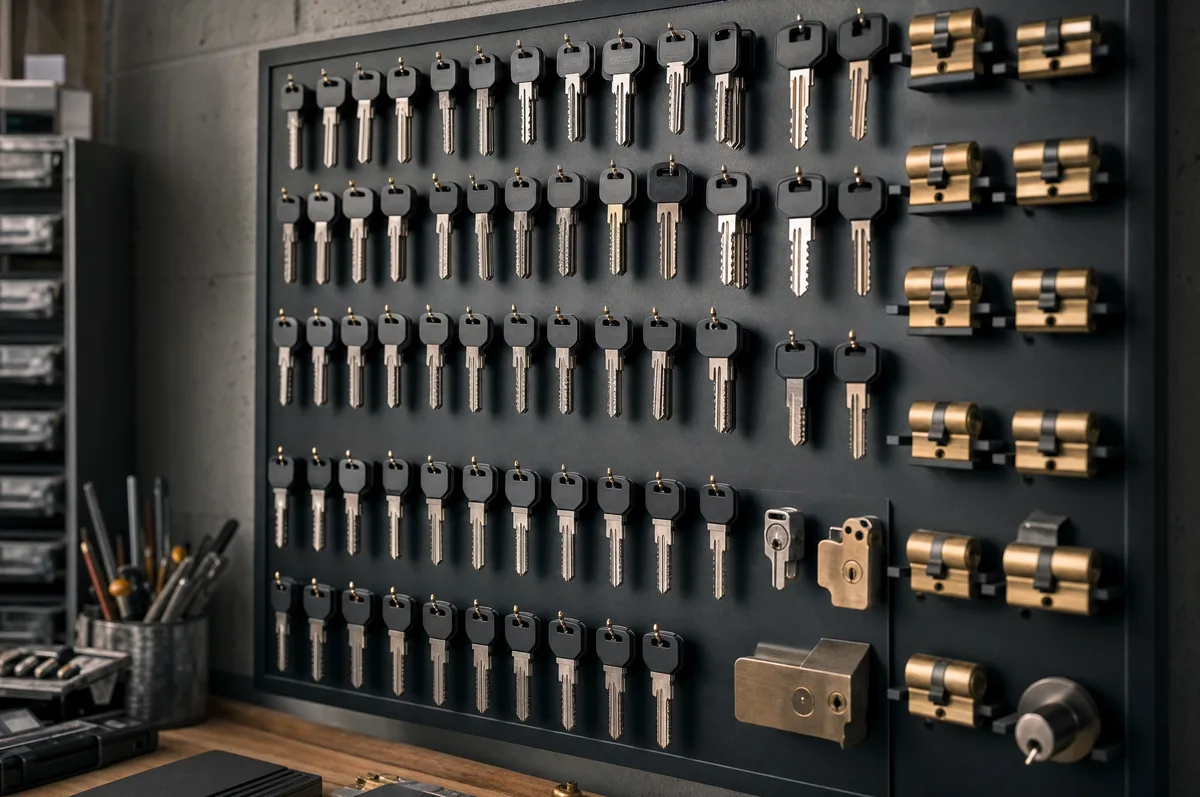
A master key system lets a business control exactly who can open which doors, using a hierarchy of keys - from a differ key (one door only) up to a grand master key (every door on site). It is the standard access-control solution for offices, HMOs, schools and retail premises that need layered access without electronic keypads or fobs, and it works with no batteries, no software and no network. Two decisions define the cost and the security: how many tiers you need, and whether the cylinders use a restricted key profile, where blanks are supplied only to the registered locksmith. City Locksmith London designs, quotes and installs bespoke master key suites across all London postcodes following a free site survey, with fully insured, DBS-checked engineers and no call-out fee.
What Is a Master Key System?
A master key system is a mechanical keying arrangement in which a single lock cylinder can be opened by more than one key. At its simplest, a building manager carries one key that opens every door, while each employee or tenant carries a key that opens only the doors relevant to them. The two keys are cut to different codes, yet both rotate the same cylinder - achieved by adding extra pins inside the lock called master wafers.
Master key systems sit entirely within conventional mechanical locks - euro cylinders, oval cylinders, mortice locks, rim cylinders - with no batteries, software, or network connection required. This makes them highly reliable and straightforward to maintain.
For businesses that want a step up in key control, commercial locksmith services that include master keying can be combined with restricted-profile cylinders (see below) to prevent unauthorised key duplication.
The Key Hierarchy: Change Key, Master Key, Grand Master
Understanding the hierarchy is the foundation of planning any suite.
Change Key (Differ Key)
The change key - sometimes called a differ key or user key - is the individual’s key. It opens one specific lock (or a defined group of locks the user needs) and nothing else. This is what a tenant, employee, or classroom teacher typically carries.
Master Key
The master key opens every change-key lock within a single defined zone - for example, an entire floor, a single building, or all the rooms in an HMO. A facilities manager, floor supervisor, or landlord typically holds the master key for their area of responsibility.
Grand Master Key
The grand master key sits one level above the master key and opens every zone beneath it. In a multi-floor office building, each floor manager might hold a master key for their floor, while the building manager holds a grand master key covering all floors.
Great Grand Master Key
For multi-site businesses or large estates, a great grand master key sits at the very top of the hierarchy, opening every zone across every building in the system. Senior executives or estate managers in large organisations typically hold this tier.
A practical example for a medium-sized office:
| Role | Key type | Access |
|---|---|---|
| Individual employee | Change key | Own office + communal entrance |
| Department manager | Sub-master | All offices in their department |
| Facilities manager | Master key | All departments in the building |
| Group director | Grand master | All buildings on the site |
The number of tiers you actually need depends on the size and structure of your organisation. A small office with ten staff may only need two tiers; a school or multi-site retailer may need four. City Locksmith London will assess your requirements and recommend the minimum number of tiers that achieves your access-control goals - more tiers than necessary increases complexity without adding security.
Keyed-Alike vs Master-Keyed: Which One Do You Need?
These two terms are frequently confused.
| Feature | Keyed-alike | Master-keyed |
|---|---|---|
| How locks differ | All locks have identical pins | Each lock has unique pins |
| Key count per user | One key opens all | One differ key per zone; master opens all |
| Access hierarchy | None - one key, all doors | Full hierarchy (differ, master, grand master) |
| Best suited to | Small offices, internal doors, storage units with no access tiers needed | Any property with multiple users at different access levels |
| Security level | Lower - one lost key compromises all locks | Higher - a lost differ key affects only that user’s zone |
Keyed-alike is the simpler and cheaper option. If you have a single lock-up unit, a set of internal office doors, or a small team where everyone legitimately needs access to the same doors, keyed-alike delivers convenience without the complexity of a full suite.
Master-keyed is the correct choice whenever access must be tiered. If a landlord should open all rooms but tenants should open only their own, if a manager should access the server room but staff should not, or if a school caretaker needs site-wide access while teachers need only their classroom block - those all require a master-keyed system.
A keyed-alike group can also be embedded within a master-keyed suite. For example, all communal doors on a floor might be keyed alike for that floor’s staff, while the floor manager’s master key still opens every lock including individual offices.
Restricted and Patented Key Systems: Preventing Unauthorised Copies
One of the most important enhancements to any master key suite is the use of a restricted key profile.
In a standard (unrestricted) cylinder, the key blank is commercially available. Anyone with the key can walk into a key-cutting shop and have copies made in minutes. For an HMO tenant, a departing employee, or a contractor who has left site, this is a clear security risk.
Restricted cylinders use a proprietary key profile that is:
- Patented - protected by a registered patent. Under the UK Patents Act 1977, a granted patent runs for a maximum of 20 years from the filing date provided renewal fees are paid, so blank keys stay off the open market for the life of the patent. Ask your locksmith how long the profile you are being quoted has left to run, because copy control weakens once a patent lapses.
- Supplier-controlled - blanks are only issued to the authorised locksmith who registered the suite, and only cut on specialist equipment.
- Authorisation-card protected - additional keys can only be ordered by the registered keyowner, with a signed authorisation card. The locksmith verifies identity before cutting any new key.
This means a tenant, an ex-employee, or anyone else who finds or steals a key cannot have it copied at a hardware shop or key bar. If a restricted key is lost, you call your locksmith, report it, and order a replacement - the key remains unique throughout.
For most commercial applications - offices, HMOs, schools, care homes - a restricted-profile master key suite is the recommended baseline. The additional cost over an unrestricted cylinder is modest relative to the security and management benefit.
Key restriction and attack resistance are two different things, and a cylinder can have one without the other. Restriction stops the key being copied; a TS 007 3-star or Sold Secure SS 312 Diamond rating stops the cylinder being snapped, drilled, picked or bumped. For any external door, specify both. Our guide to high-security locks and when you need them explains how those ratings are tested.
Which Businesses Use Master Key Systems?
Offices and Commercial Premises
An office building with multiple departments and a shared reception is the classic application. The building manager holds a grand master key. Each department head holds a master key for their area. Individual employees hold change keys for their own office and any shared rooms - the meeting room, the kitchen, the print room - that their role requires. The IT server room and finance office can be restricted to specific change-key holders with no master key access if required by policy.
HMOs and Residential Lettings
Commercial locksmith services for landlords frequently include master key suite design. A typical HMO setup gives each tenant a differ key for the shared front door and their own bedroom. The landlord holds a master key for all rooms. A cleaning contractor might hold a sub-master key for communal areas only. With a restricted cylinder, tenants cannot copy their key at a high-street key bar, which removes the most common route to an uncontrolled key in circulation. Restriction is a practical control rather than a licensing requirement in itself, but it makes it far easier to show a licensing officer that key issue is managed.
The Fire Safety Constraint Landlords Miss
A master key suite in an HMO has to respect escape requirements, and this catches people out. The LACORS Housing - Fire Safety guidance, which councils and fire services across England and Wales treat as the benchmark for HMOs, is clear that doors on escape routes must be openable from the inside without a key, and that where a security lock is fitted it should have a suitable internal thumb-turn.
In practice that means a bedroom door in an HMO wants a lock that is key-operated from the outside but releases instantly from the inside. In British Standard terms, that is BS 8621 (keyless egress) rather than BS 3621 (key egress, which needs a key on both sides). Bedroom doors are usually fire doors too, so the ironmongery must not stop the door closing fully onto its seals.
A master key suite handles all of this without difficulty - thumb-turn cylinders master-key perfectly well - but it has to be specified that way from the start. Tell your locksmith at survey stage which doors sit on an escape route.
Schools and Educational Sites
Schools require highly granular access control. Teaching staff need access to their classroom block, staff rooms, and shared facilities. Department heads need access to all rooms in their department. The site caretaker needs site-wide access. Senior leadership may require a grand master key for all buildings on the campus. Restricted-profile cylinders prevent students or unauthorised visitors from copying keys.
Retail and Hospitality
A retail chain with multiple units can use a grand master suite in which regional managers hold a grand master key for all stores in their region, store managers hold a master key for their individual store, and staff hold differ keys for the trading floor, stockroom, or till area as appropriate. Hospitality venues can configure similar arrangements for front-of-house, back-of-house, and management areas.
Care Homes and Healthcare
Care homes use master key systems to balance resident privacy with staff access requirements. Residents hold differ keys to their own rooms; care staff hold master keys for their wing; senior managers or duty managers hold grand master keys for the full building. In an emergency, the grand master key guarantees instant access to any room without delay.
What Should You Decide Before Installing a Master Key Suite?
Plan for growth. A well-designed suite has headroom - room to add more locks, more tiers, or more differ keys as the business grows. A locksmith designing the suite at the outset can build in this capacity; retrofitting it later is significantly more complex.
Document everything. Keep a key register - a record of who holds which key, with a unique serial number for each. If a key is lost, the register tells you immediately which lock zones are at risk and which differ keys are affected.
Plan for key loss. With a restricted system, a lost key cannot be copied, which contains the immediate risk. However, you should still have a protocol: who to call, how quickly cylinders will be replaced, and who authorises replacement keys. The locksmith who designed the suite should be your first call.
Understand the cylinder type. Master key suites can be built on euro cylinders (the most common in UK uPVC and composite doors), oval cylinders, Scandinavian cylinders, and mortice locks. The cylinder type depends on your existing door hardware. A site survey confirms what is fitted and what options are available.
Security rating vs key restriction. Key restriction prevents copying; a security-rated cylinder (TS 007 3-star, Sold Secure SS 312 Diamond) resists physical attack. For high-risk premises, you want both. For lower-risk internal doors, key restriction alone may be sufficient.
Understand the inherent trade-off. Every master wafer added to a pin stack creates an extra shear line, and extra shear lines mean more key cuts will turn the cylinder than in a single-keyed lock. This is well understood in the trade and in the security literature - it is why a suite should have no more tiers than it genuinely needs, and why a high-quality cylinder platform matters more in a master-keyed system, not less. More tiers than necessary adds complexity and reduces security at the same time.
Only master-key the doors that need it. Doors on escape routes need keyless egress from the inside (see the HMO note above). Server rooms, cash offices and record stores are often better left off the master entirely, with access limited to named differ-key holders.
How to Get a Master Key System Designed and Installed
Designing a master key suite is a bespoke process. There is no off-the-shelf package, because every site has a different number of doors, different access zones, different user groups, and different cylinder types. The process typically follows these steps:
- Site survey - a locksmith visits to count the doors, identify the cylinder types, understand the access zones, and map out who needs access to what.
- Suite design - the locksmith produces a keying matrix: a document listing every lock, every differ key, and every master key in the system, with the access rights of each.
- Cylinder specification - the locksmith selects a cylinder range (standard or restricted-profile) that meets your security requirements and fits the existing door hardware.
- Installation - cylinders are replaced or repinned across the site, keys are cut and serialised, and the key register is set up.
- Handover - you receive the keys, the register, and the authorisation card for future key orders.
City Locksmith London provides a free, fixed quote for master key suite design and installation across all London postcodes, with no call-out fee. Our engineers are fully insured, DBS-checked, and have over 15 years of experience designing master key suites for offices, HMOs, schools, retail premises, and care homes across Greater London.
Iulian H., lead locksmith at City Locksmith London, says: “We design the suite with the minimum number of tiers that actually does the job, and we agree the full price after the survey and before any cylinder is ordered. A suite with more levels than the business needs is harder to manage and no more secure.”
If the survey shows individual doors need work before the suite goes in, our door lock installation and lock change services cover the remedial hardware.
To arrange a free site survey, contact a locksmith or visit our locksmith services page for a full list of what we cover.
Other Common Questions About Master Key Systems
Is a master key system the same as an access-control system?
Not exactly. Access-control systems typically use electronic credentials - fobs, cards, PINs, or biometrics - and can be managed and audited remotely via software. Master key systems are purely mechanical, with no electronics, no power requirement, and no software. They are generally less expensive to install and maintain, do not depend on batteries or network connectivity, and are a natural fit for buildings where electronic systems would be impractical or disproportionate.
For businesses that want both the convenience of electronic access on high-traffic doors and the simplicity of mechanical keying on lower-traffic areas, a hybrid approach is possible. Our commercial locksmith services include both.
Can I have a master key system on uPVC or composite doors?
Yes. Most uPVC and composite doors use euro cylinder locks, which are available in restricted-profile master key suites. The cylinder is simply swapped out during installation. Measure your existing cylinder (from the centre of the retaining screw to each end) before booking a survey, so your locksmith arrives prepared with the correct sizes.
Do I need planning permission to install a master key system?
No. Master key systems are entirely internal changes to existing locks. They do not alter the building fabric and do not require planning permission or building regulations approval.
Where can I see the full range of lock and security services available?
Visit our locksmith services page or our locksmith price list for an overview of all services we provide. Master key suites are quoted individually following a free survey.