

How to Protect Your Car from Keyless Theft and Relay Attacks
By Iulian H., Lead Locksmith · Updated
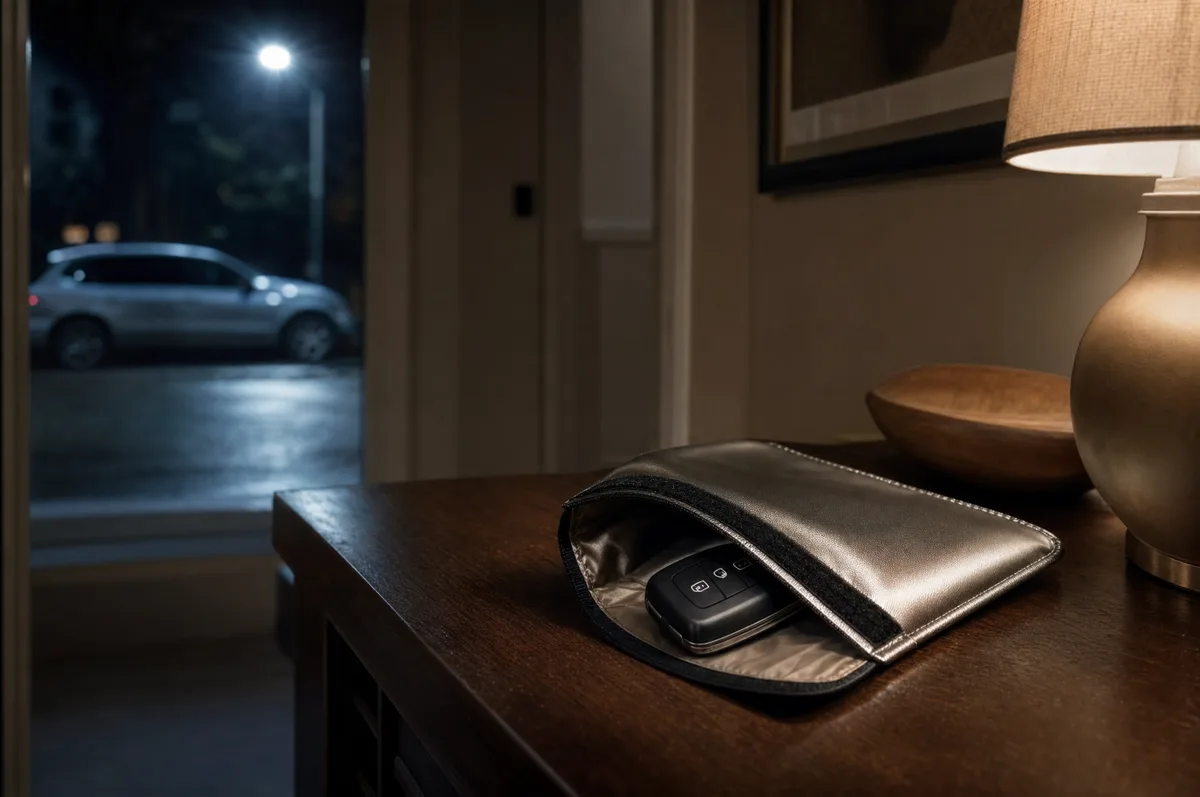
City Locksmith London: signal-based attacks are now the single most common way cars are stolen in England and Wales. According to the ONS Crime Survey for England and Wales (Nature of crime: vehicle-related theft, year ending March 2025), the offender manipulated the signal from a remote locking device in 46.7% of thefts of vehicles - more than any other method - and the Home Office reports that the Metropolitan Police estimates electronic devices are used in approximately 60% of vehicle theft in London. A standard factory immobiliser is no defence. The most effective single countermeasure is an aftermarket PIN immobiliser (commonly called a ghost immobiliser), because it demands a code the relayed signal cannot supply. Layer it with a Faraday pouch, an OBD port lock, and a visible physical deterrent.
How Keyless Car Theft Works
Modern cars with keyless entry broadcast a low-power radio signal from the key fob. When the fob is within range - usually a metre or two - the car unlocks automatically. Criminals have developed several ways to exploit this.
The relay attack - signal amplification
The most widespread method involves two criminals and two electronic devices. One stands next to your parked car carrying a relay transmitter. The other walks up to your front door carrying a signal amplifier. The amplifier captures the faint signal your key fob emits from inside your home - through the door, walls, or hall table - and forwards it to the transmitter beside the car. The car receives what it believes is a genuine, close-range key signal, unlocks, and allows a keyless start. It leaves no trace of forced entry, which is why many owners assume at first that the car has been towed.
The ONS data confirms where and when this happens. In the year ending March 2025, 67% of thefts of vehicles happened at or near the owner’s home - 13.6% on private property, 37.3% in a semi-private location such as a driveway or residents’ car park, and 16.1% on the street outside. 75.3% happened in the evening or at night, and 71.7% in the dark (ONS, Nature of crime: vehicle-related theft, year ending March 2025).
Recovery is the exception, not the rule. Of vehicles stolen in that year, only 25.6% were returned to their owner.
OBD and CAN bus injection
A smaller but growing category of thefts bypasses the wireless signal altogether. In an OBD attack, criminals gain brief physical access to the interior - sometimes by slipping a tool through a door seal - to reach the diagnostic port beneath the steering column. A device plugged into that port can be used to programme a blank key fob, giving permanent access. Thieves carrying out a CAN bus injection access the vehicle’s wiring through a more exposed entry point - frequently the headlight housing - and connect directly to the car’s internal network to send unlock and start commands. Both methods require momentary physical proximity rather than a relayed wireless signal.
What the rest of the thefts look like
Signal manipulation is the biggest single category but it is not the only one. In the same ONS dataset for the year ending March 2025, the offender used a key or electric fob in 16.7% of thefts of vehicles, forced a lock in 16.6%, found the door not locked in 14.5%, and broke a window in 8.0%. Roughly one in seven stolen cars was simply unlocked - so the cheapest defence is still to check the car locked before you walk away.
How to Protect Your Car: A Layered Defence
No single measure is foolproof. Criminals adapt, and a determined, well-resourced gang will probe any single layer of security. The aim is to make your vehicle a harder target than the one parked next door.
Prevention checklist
| Measure | Approximate cost | What it stops | Effectiveness |
|---|---|---|---|
| Faraday pouch (quality, tested) | £10-£30 | Relay signal capture | High - if used consistently |
| Metal tin / steel cashbox | Under £20 | Relay signal capture | High overnight storage |
| PIN (ghost) immobiliser, e.g. Autowatch Ghost-III | £400-£600 fitted (typical market range) | Relay attack start; OBD key programming | Very high |
| OBD port lock / cover | £20-£60 | OBD key programming | Moderate (physical barrier only) |
| Steering wheel lock | £25-£80 | Opportunistic theft; deterrent | Moderate - visible deterrent |
| Wheel clamp | £30-£100 | Vehicle movement | Moderate - visible deterrent |
| Driveway alarm / CCTV | £50-£300 | Early warning; evidence | Moderate |
| Keyless-off (manufacturer setting) | Free | Relay attack | High where available |
| Park front-against-wall | Free | CAN bus / headlight attack | Low-moderate |
Faraday pouches: use them correctly
A Faraday pouch lined with metallic mesh blocks the radio frequency your key fob emits. This prevents a nearby amplifier from capturing the signal. To be effective:
- Use it every time, not just occasionally.
- Test it monthly - key inside the pouch, walk to the car and try the door handle. The car should not respond.
- Replace it every 6 to 12 months. Daily folding and wear degrades the lining.
- As an alternative for overnight storage, a sealed metal tin or small steel cashbox achieves the same shielding effect at lower cost.
Even placing keys on a kitchen table rather than a hall table - further from the front door - meaningfully reduces how easily a signal can be captured from outside.
Ghost immobiliser: the most robust electronic defence
A ghost immobiliser connects directly to the vehicle’s CAN bus. It requires the driver to press a sequence of existing cabin buttons - on the steering wheel, dashboard, or centre console - before the engine will start. It emits no radio frequency signal that thieves can detect. If a criminal unlocks the car via a relay attack and gets behind the wheel, they cannot start the engine without the PIN sequence.
The device is typically installed covertly, with no visible wiring or tell-tale switches. The Autowatch Ghost is the most widely installed unit in the UK; Autowatch is phasing out the single-network Ghost-II in favour of the Ghost-III, which supports dual CAN networks and high-speed CAN-FD for newer vehicles. Other brands include Pandora and Scorpion.
Be careful with the phrase “Thatcham approved”. Autowatch states the Ghost is TASSA verified, not Thatcham categorised. Thatcham’s S5 and S7 categories are tracker categories, not immobiliser categories, so an advert offering a “Thatcham S7 ghost immobiliser” is describing two different products. What matters for a claim or a discount is what your own insurer accepts, in writing, and that the installer issues an installation certificate. Ask before you buy.
Fitting cost is typically included in the quoted price by a specialist installer. Our auto locksmith team in London can advise on aftermarket security options and arrange professional installation.
Turning off keyless entry
Some manufacturers allow the passive keyless function - where the car senses the fob and unlocks without a button press - to be disabled via the infotainment menu or by holding a button sequence on the fob. Check your vehicle handbook. If the feature can be switched off, the car requires you to press the fob button to unlock, which means no passive signal is emitted and a relay attack has nothing to capture.
OBD port protection
Fitting a physical OBD lock or cover makes it harder for criminals to access the diagnostic port quickly. On its own this is a moderate measure - a determined thief with time and tools can still remove it. The more robust approach is to pair an OBD cover with a ghost immobiliser: even if a new key is programmed through the port, the immobiliser still prevents the engine from starting without the PIN.
Physical deterrents
Steering wheel locks, wheel clamps, and driveway posts have lost none of their value. Most relay-attack thieves operate quickly and target easy vehicles. A visible steering lock signals that the car will require additional time and noise to move - enough to deter a significant share of opportunistic criminals. Parking with the front of the car close to a wall or garage door also limits access to the headlight area used in CAN bus injection attacks.
Is It Illegal to Own a Relay Device in the UK?
Yes, as of 2026 it is. The Crime and Policing Act 2026, which received Royal Assent on 29 April 2026, created two new offences covering electronic devices used in vehicle theft: one for possessing such a device, and one for importing, making, adapting, supplying or offering to supply it. According to the Home Office factsheet published on GOV.UK, the offences cover signal jammers, signal amplifiers, devices used to access a vehicle’s wiring system, and devices that unlock a car when touched against the door handle. The maximum penalty is five years’ imprisonment, an unlimited fine, or both.
Before this, the devices themselves were not illegal to possess, and police had to prove intent under “going equipped” offences. The new offences require only a reasonable suspicion that the device will be used in connection with vehicle theft, which lets police act before a car is taken.
The same factsheet is the source of the London figure quoted at the top of this article: the Metropolitan Police estimates that electronic devices are used in approximately 60% of vehicle theft in the capital.
It does not change what you should do. The law raises the risk for the thief; the Faraday pouch, the PIN immobiliser and the steering lock still decide whether your car is the easy one on the street.
If Your Car Is Stolen: What to Do
If you discover your vehicle has been taken, call 999 immediately if the theft is in progress, or 101 to report it after the fact. Note the time you last saw it, the parking location, and whether any unusual activity was noticed nearby. Inform your insurer promptly. If you have a GPS tracker fitted, provide the tracking company’s details to police so they can coordinate a real-time recovery - tracked vehicles have significantly higher recovery rates.
City Locksmith London cannot recover a stolen vehicle, but we can help after the fact: contact us for a spare key cut and programmed, a replacement key fob, or advice on upgrading your vehicle’s security before you use the car again. Car key programming from £85 ex VAT; locked out of your car from £109 ex VAT. See the full locksmith price list for all automotive services.
How We Can Help
City Locksmith London is a 24/7 auto locksmith service covering all London postcodes, with a 25-minute response target and over 15 years of experience. Our technicians are DBS-checked, fully insured, and carry no call-out fee. We can supply and programme spare keys for a wide range of makes and models, and advise on aftermarket security upgrades suited to your vehicle.
Iulian H., lead locksmith at City Locksmith London, says: “We agree the price with you before any work starts, and we open vehicles non-destructively wherever the lock and the vehicle allow it, so you are not paying for damage on top of a replacement key.”
If you have been locked out, lost your keys, or need security advice after a suspected relay-attack attempt, get in touch for a free quote.
For context on how residential burglaries work alongside vehicle crime - criminals sometimes target both the car and the house in a single visit - see our related article on how burglars break into houses in London.
For cost guidance on replacement and spare key services, read our guide to how much it costs to replace a car key.
Frequently Asked Questions
See the FAQ section above for concise answers to the most common questions about relay attacks, Faraday pouches, ghost immobilisers, OBD theft, CAN bus attacks, keyless-off settings, and insurance cover.